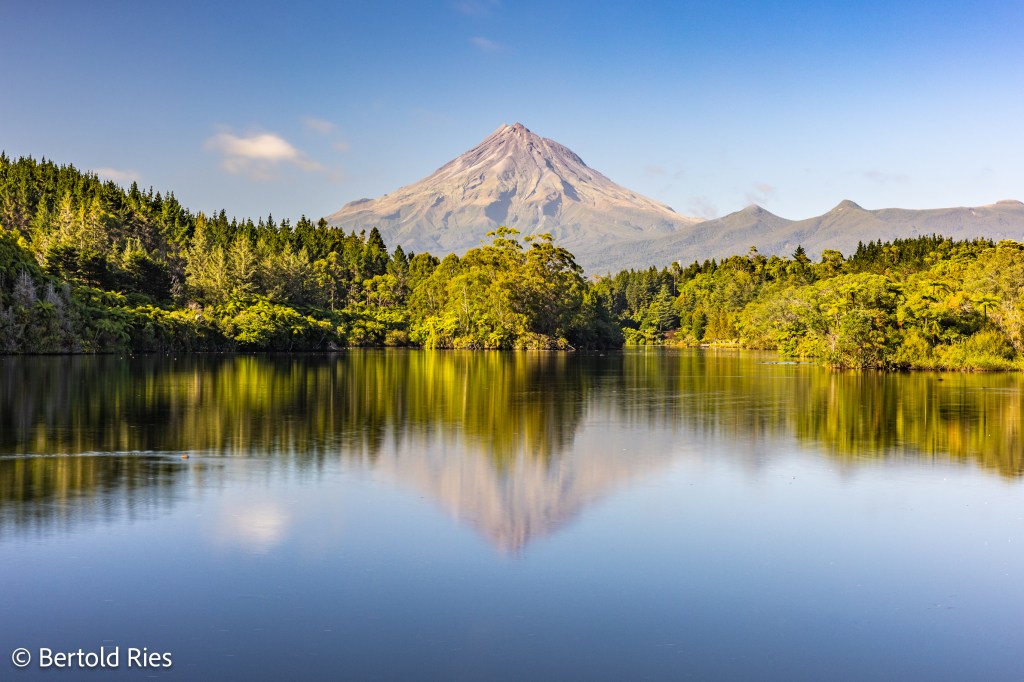
No, it’s not Mount Fuji from Japan. It’s Mount Taranaki (2’518 m.a.s.l.) located on the southwest of the northern island of New Zealand. The view from Lake Mangamahoe near New Plymouth is fascinating in particular early in the morning when the view is clear and sun lets the rainforrest shine is many shades of green.
For this photo I chose a long exposure of 4 seconds to flatten the little waves in the lake and to create the mirror effect.
A couple of hours drive northeast from Mount Taranaki is the Tongariro National Park with several vulcanos. Mount Ruapehu (2’797 m) is New Zealands highest vulcano. Here the view from southwest.
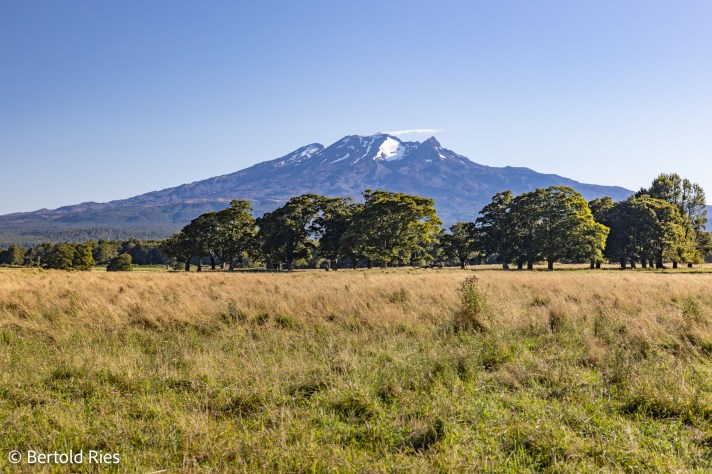
There is also a cable car that goes up the vulcano to 2’020 m.a.s.l. and with a steep hike up (called “skyline walk”) one can reach a great lookout at 2’290 m.a.s.l. (picure below). On the right one can see Mount Ngauruhoe ( 2’291 m.a.s.l.) with the lower Tama Lake.

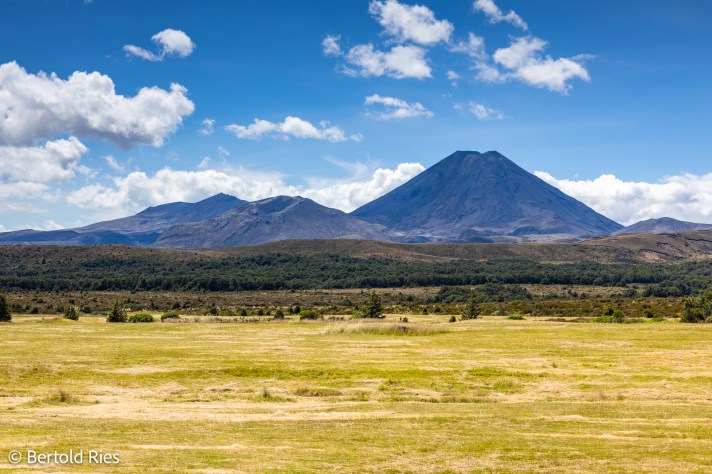
Without the clouds Mount Ngauruhoe reveals its the perfect cone-shape. Here the view from the east:

From the west one can also see nicely Mount Tongariro (1’978 m.a.s.l). All these vulcanos are still active.
Two hours drive northwest close to Rotorua is Mount Tarawera (1’111 m.a.s.l.) – today a sleeping volcano. But on June 10th 1886 it erupted and caused one of the most significant catastrophes in New Zealand and destroyed the world-famous Pink and White Terraces which could have been a quite nice photo-sujet too. On the other hand the view straight into the fissure as in the picture below also shows stunning colors.

There are many more vulcanos in New Zealand. In my next post I’ll feature the active geothermal area “Wai-O-Tapu” – another quite unique place to see.
 structures & shapes
One response to “New Zealand’s Volcanos”
[…] I’d like to finish this post with my favorite lake on the North Island: Lake Mangamahoe close to New Plymouth. The scenery with Mount Taranaki – the New Zealand version of Mount Fuji – is just breathtaking. More about Mount Taranaki you can find here. […]
LikeLike